Data-driven business decisions are essential in today’s data-rich landscape, turning raw information into reliable strategic guidance. By grounding choices in analytics, organizations respond faster to market shifts, optimize operations, and maintain a competitive edge in a rapidly evolving environment. This approach relies on clean data, robust governance, and a repeatable process that connects insight to action across departments. The goal is to translate actionable insights into concrete steps that leaders and teams can implement with clarity and accountability. Taken together, a well-defined data strategy helps executives assess progress and demonstrate how data informs strategic bets.
In practical terms, organizations pursue data-informed decisions that align with business goals and are guided by evidence rather than gut feeling. This perspective incorporates business intelligence, cross-functional governance, and transparent dashboards to monitor progress and validate hypotheses. By framing strategy around reliable insights and clear ownership, teams can translate discoveries into concrete actions with accountable owners. A repeatable, scalable process helps ensure consistency as data quality, governance, and maturity grow across the organization. Ultimately, this approach makes decision making more resilient, faster, and more aligned with customer value.
1) Why data-driven decisions matter in modern organizations
Data-driven decisions matter because they rest on verifiable patterns and measurable outcomes rather than gut feel. When organizations leverage analytics to inform strategy, they reduce guesswork, shorten decision cycles, and improve forecasting accuracy. Rather than chasing every new metric, they focus on the ones that align with strategic goals and drive tangible results.
Adopting a data-driven decision making mindset requires balancing evidence with judgment. Data should guide choices, but it should not replace expertise. Build a culture where insights are discussed in context, questions are tested, and dashboards provide a clear picture of what to do next.
2) Foundations for reliable analytics: data quality, governance, and alignment
A reliable analytics program starts with clean, integrated data and a governance framework that enforces consistency. Data quality is an ongoing practice—cleaning, deduplication, and validation rules ensure trust in analyses. Align analytics initiatives with business objectives by identifying a small set of high-leverage metrics that matter to revenue, customer satisfaction, and efficiency.
Create a single source of truth—whether a data warehouse or data lake—that consolidates data from sales, marketing, product, finance, and operations. When data sits in silos, insights are fragmented and actions can conflict. Establish data ownership and governance policies for access, privacy, and lifecycle management to enable reliable analytics and consistent reporting.
3) From data to decisions: a repeatable workflow
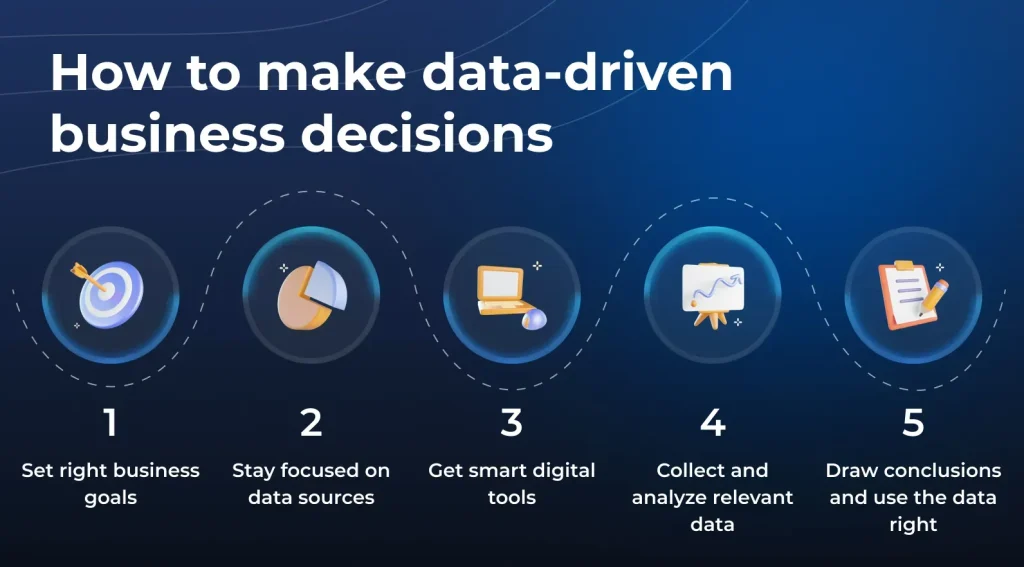
The most effective organizations implement a repeatable workflow that turns analytics into action. Start with data collection and cleansing, ensuring sources are accurate and up to date. Build a unified view by integrating data from CRM, ERP, web analytics, and support systems, so you can analyze cross-functional relationships and identify new opportunities.
Define metrics and KPIs that reflect strategic priorities—revenue growth, churn reduction, time to market, and operational efficiency. Create dashboards that present these metrics in clear, actionable ways, with real-time or near-real-time updates. Then interpret insights with a pragmatic lens, translate analyses into concrete recommendations, specify owners and deadlines, and measure impact against the original goals.
4) The power of dashboards, metrics, and actionable insights
Dashboards translate complex analyses into visuals decision-makers can absorb quickly. A well-designed dashboard highlights leading indicators, ties each metric to a business outcome, and makes ownership explicit. Well-defined metrics have precise calculations, targets, and accountability, reducing ambiguity and speeding action.
Beyond visuals, cultivate actionable insights by framing findings as recommended actions with clear next steps. Specify who will act, what they will do, and by when, turning data into a concrete plan rather than a collection of observations. Use these insights to drive decisions that move the business forward.
5) Cultivating a data-driven culture and capability
Culture is the key to sustaining a data program. Promote data literacy across all levels with training, self-serve analytics tools, and clear documentation so employees can access and interpret data confidently. Democratizing data—while maintaining governance—empowers teams to experiment, iterate, and learn from outcomes.
Guard against vanity metrics that look impressive but don’t influence decisions. Instead, emphasize metrics with real business impact and explicitly link analyses to strategic priorities. When people see how data informs real outcomes, they become more engaged with data-driven decision making and more likely to adopt new tools and processes.
6) Practical steps to implement Data-driven business decisions in your organization
Start with a pragmatic 90-day pilot focused on a single department or problem with clear success criteria. Build a small cross-functional team including a data engineer, a product or operations owner, and a business lead who can champion the initiative. In the first month, establish data sources, create a basic data model, and define the core metrics that will drive the effort.
In month two, develop dashboards that deliver real-time insights and run controlled experiments to test hypotheses. By month three, extend the approach to additional use cases and begin standardizing processes for data-driven decision making across teams. Document learnings and build a playbook that scales with the organization, ensuring governance, data quality, and measurable outcomes remain at the core of every decision.
Frequently Asked Questions
What is data-driven decision making and how does analytics support it in practice?
Data-driven decision making relies on evidence from analytics to guide choices. By analyzing patterns, trends, and causal relationships, analytics reduces guesswork, speeds decision cycles, and improves forecast accuracy. Use clear metrics and a disciplined approach to ensure decisions are grounded in data.
How do dashboards facilitate turning analytics into actionable insights for strategic decisions?
Dashboards visualize analytics results so leaders can quickly see how key indicators affect outcomes. Each metric should have a defined calculation, target, and owner to translate insights into concrete actions. A well-designed dashboard bridges data and decision making, prompting timely, evidence-based steps.
Which metrics should you track to support data-driven decisions and how do you set meaningful targets?
Track metrics that align with strategic goals—such as revenue growth, customer satisfaction, churn, and operational efficiency—and ensure each metric has a precise calculation, a realistic target, and an assigned owner. Regularly review KPI performance and adjust targets to keep decisions focused on meaningful business outcomes.
What is a repeatable workflow to move from data collection to action in data-driven decision making?
Adopt a repeatable workflow: collect and cleanse data, unify sources into a single source of truth, analyze to derive insights, and translate findings into concrete actions with owners and deadlines. Use controlled experiments to validate hypotheses and measure impact, then close the loop by learning and iterating.
Why are data quality and governance foundational for reliable data-driven decisions and trustworthy dashboards?
Data quality and governance ensure data is accurate, consistent, and compliant, creating a trustworthy data foundation. A single source of truth with clear ownership and governance policies enables reliable analytics and dashboards, which in turn support confident data-driven decisions.
How can you measure the impact of data-driven decisions and continuously improve through experimentation?
Measure impact by comparing results to initial goals and using controlled experiments when possible. Track outcomes over time, learn from successes and failures, and iterate on models, dashboards, and processes to sustain a cycle of continuous improvement in data-driven decision making.
| Key Area | Summary |
|---|---|
| Introduction | Data-driven decisions are a strategic necessity that requires a structured analytics approach, strong data quality and governance, and clear ownership to turn data into actions aligned with business goals. |
| Why data-driven decisions matter | They outperform intuition by relying on verifiable patterns and measurable outcomes, reduce guesswork, shorten decision cycles, and focus on metrics that align with strategic goals, while augmenting judgment with context. |
| Foundation: data quality, governance, and alignment | Clean, integrated data with a governance framework; define high-leverage KPIs; establish a single source of truth; assign ownership and policies for privacy and lifecycle management; avoid data silos. |
| From data to decisions: a repeatable workflow | A repeatable sequence: collect and cleanse data, create a unified view, define KPIs, build dashboards, interpret insights, run experiments, measure impact, and learn—closing the loop for continuous improvement. |
| Dashboards, metrics, and actionable insights | Dashboards highlight leading indicators and tie metrics to business outcomes; ensure precise KPI calculations, targets, and owners; present actionable recommendations with clear next steps. |
| Cultivating a data-driven culture and capability | Promote data literacy, provide training and self-serve tools, democratize data with governance, avoid vanity metrics, and link analyses to strategic priorities to foster adoption. |
| Practical steps to implement Data-driven business decisions in your organization | Run a 90-day pilot with a cross-functional team; establish data sources, a basic data model, and core KPIs; create dashboards and experiments; scale across teams and standardize processes. |
| Common pitfalls and how to avoid them | Beware data silos and overly complex models; avoid inferring causation from simple correlations; ensure clear owners, deadlines, and governance, including privacy and compliance. |
| Real-world scenarios: a quick illustration of turning analytics into action | Example: a retailer unifies website analytics, campaigns, and support data to identify checkout frictions, defines a KPI for checkout completion, runs controlled experiments, and measures uplift in revenue and insight into actions. |
Summary
Data-driven business decisions rely on disciplined analytics, a culture of learning, and a robust process that converts insights into concrete actions. By aligning data with strategic objectives, investing in data quality and governance, and building dashboards and metrics that guide decisions, organizations can turn analytics into action at scale. The journey from data to decision is ongoing, emphasizing iteration, measurement, and learning to improve outcomes for customers and the bottom line. When data informs key choices, organizations become more agile, more resilient, and better positioned to seize opportunities in a fast-changing world.